
Sea Wolf (Ocean Cleanup)
McKinsey’s strategic alignment scenario, introduced in 2024. Design a 3-microbe treatment for three ocean sites — each with its own target characteristics, desirable traits, and traits to avoid.
What is the Sea Wolf scenario?
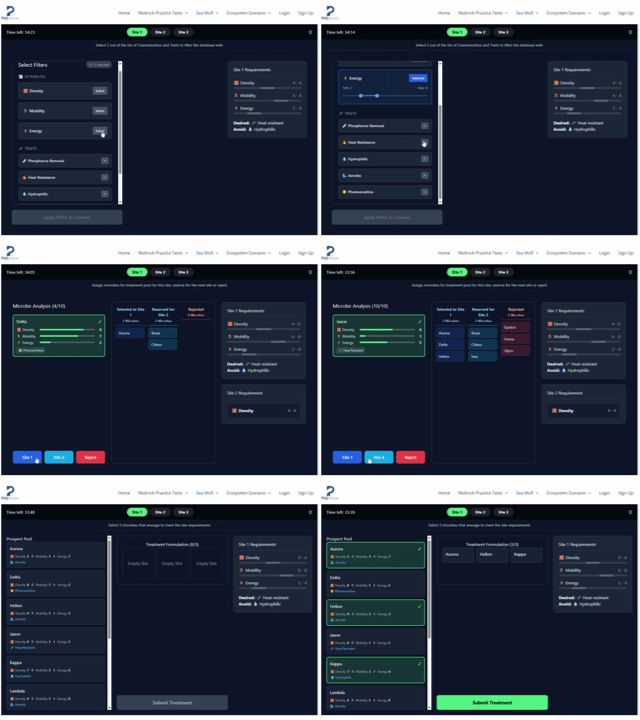
Sea Wolf is McKinsey’s ocean-cleanup simulation, added to the Solve assessment in spring 2024. You act as a researcher tasked with cleaning three contaminated ocean sites. For each site, you must select a combination of three microbes whose averaged characteristics fall within the site’s target ranges — for example, Energy 2–4, Mobility 7–9, Density 4–5.
Each site also defines traits to avoid and desirable traits. If your 3-microbe solution contains an avoid trait, you incur a score penalty. Including desirable traits boosts your score. The highest-scoring solution is one where the average value of each characteristic across your three chosen microbes sits within the target range, while avoiding penalised traits and incorporating desirable ones. The environment — and therefore the optimal combination — differs meaningfully across all three sites.
Format & timing
For each of the three sites, you select three microbes and the game calculates the average score across each characteristic. To score well, those averages must fall within the site’s target ranges. You must also check the site’s avoid traits — any avoid trait present in your solution incurs a penalty — and aim to include desirable traits where possible. Each site presents a distinct optimisation challenge.
Why candidates struggle
What candidates say
10 simulations. Real past PSG data.
The largest practice library available for Sea Wolf — ten full simulations, each with the exact interface and detailed solutions for every site.
Sea Wolf FAQs
How long is the Sea Wolf scenario?
Sea Wolf typically lasts about 30 minutes. In that time you work through three ocean sites, designing a three-microbe treatment for each. Because the target ranges and traits differ at every site, time management and a repeatable method matter as much as the underlying logic.
How is Sea Wolf scored?
Your score is based on the average value of each characteristic across your three chosen microbes, which must fall within the site’s target ranges. Including an avoid trait triggers a penalty, while desirable traits boost your score — so balance matters more than picking individually strong microbes.
Why is Sea Wolf so hard?
Sea Wolf is challenging because each of the three sites has different target ranges and traits, the score uses averages rather than sums, and a single overlooked avoid trait can sink an otherwise strong solution. Once you internalise these rules and practise, the pattern becomes far more manageable.
How many Sea Wolf practice tests does PSG Solver include?
PSG Solver provides 10 full Sea Wolf simulations — the largest practice library available for this scenario. Each replicates the exact interface and microbe trait system, with detailed solutions for every site so you can see the optimal combination and why it works.
How should I prepare for Sea Wolf?
Build a systematic routine: check each site’s target ranges, screen out avoid traits, then test microbe combinations whose averages land in range while capturing desirable traits. Running multiple full simulations is the most effective preparation, which is why volume of practice makes the biggest difference here.