The Sustainable Futures Lab Simulator
McKinsey’s newest assessment module is live — and most candidates don’t know it’s coming. Practise with the most faithful simulation available.
McKinsey’s newest — and least understood — assessment module
The Sustainable Futures Lab (SFL) is a brand-new behavioral module added to McKinsey Solve in March 2026. It is the third game in the 85-minute version of Solve, sitting after Red Rock Study and Sea Wolf — and it is unlike either of them.
Red Rock and Sea Wolf test analytical reasoning, optimisation, and data interpretation. The SFL does something fundamentally different. It places you inside an environmental research team and asks you to make a series of connected decisions as a project unfolds in real time. There is no spreadsheet to optimise. No ecosystem to model. Just judgment, under pressure, with imperfect information.
McKinsey has described this shift as bringing a personal fit dimension into the digital assessment for the first time — evaluating how you would actually operate alongside other consultants on a project, not just whether you can solve structured problems in isolation.
“Sustainable Future Lab shifts McKinsey Solve from purely analytical evaluation to include behavioral judgment for the first time in the digital assessment… This reflects skills McKinsey has traditionally assessed through the Personal Experience Interview, now embedded in the digital assessment.”
— Candidate reports, April 2026Five behavioral dimensions. No right or wrong answers.
McKinsey does not score individual answers as correct or incorrect. It evaluates the pattern of your decisions across all 13 questions — looking for consistency, intellectual discipline, and sound judgment throughout the full sequence.
Can you identify what matters most and sequence your work accordingly? Strong candidates establish direction early and concentrate effort on the highest-impact factors — not everything at once.
Can you commit to a direction when the evidence is incomplete? McKinsey looks for a bias to action — making a reasoned call, documenting assumptions, and staying open to revision.
Can you distinguish signal from noise in complex, conflicting data? Strong candidates know when to investigate further and when to draw a directional conclusion and move on.
Can you hold multiple competing constraints simultaneously and find creative paths through them? The best responses avoid false binaries — neither optimising for one side nor deferring entirely to others.
Can you create psychological safety, surface dissent, and manage resistant stakeholders? McKinsey evaluates whether you operate effectively through people — not just on problems in isolation.
Built to mirror the real assessment
Every simulation follows the exact 13-question format, includes a drag-and-drop priority ranking question, and scores you across all five dimensions at the end — with personalised written feedback for each dimension based on how you performed.
What the real SFL looks like
The SFL sits at the end of the 85-minute Solve assessment. You receive a mission briefing — a written scenario placing your team inside an environmental project — followed by 13 connected decisions that build on each other sequentially.
The questions are not difficult in isolation. The challenge is time pressure and consistency: less than two minutes per question, with McKinsey evaluating the pattern across your full sequence of responses rather than individual answers.
The assessment is text-heavy and judgment-driven. No calculations. No data charts. Careful reading, structured thinking, and consistent decision-making under time pressure are the only tools required — and the only ones McKinsey is evaluating.
A written scenario places your team in an environmental research context, establishing the situation and your role before the questions begin.
One question asks you to rank four actions in priority order, testing task sequencing and hypothesis-first thinking. This can appear at any point in the sequence.
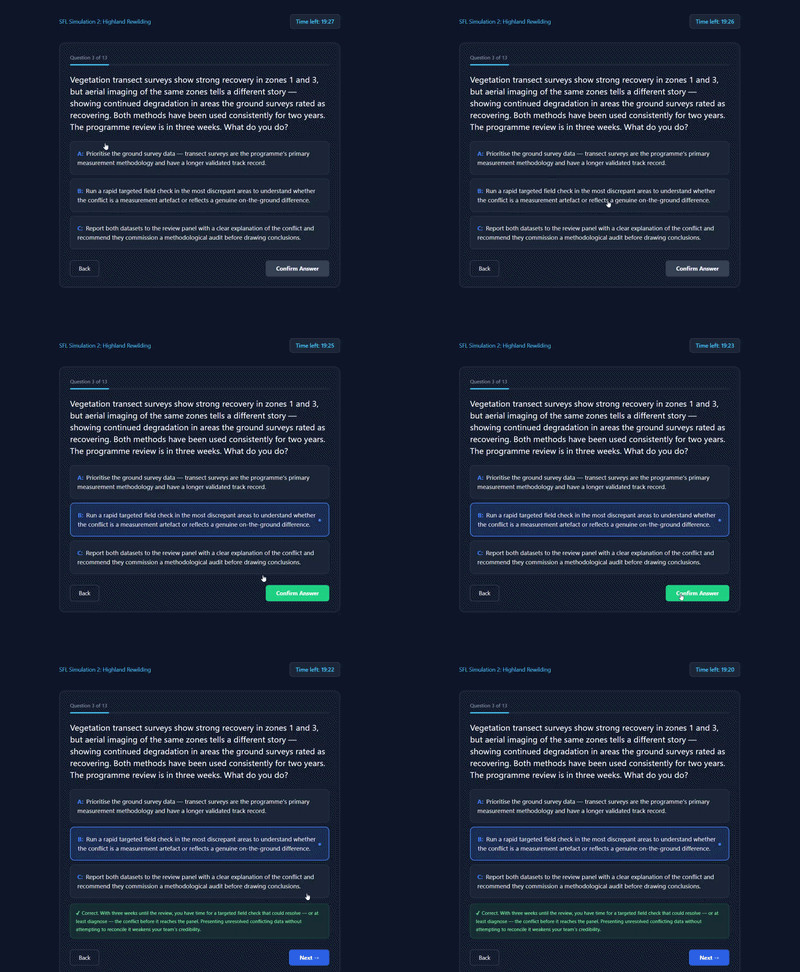
Each remaining question presents a scenario with typically three options. Scenarios evolve sequentially — earlier decisions shape the context for later ones.
McKinsey evaluates your decision pattern across all 13 questions — whether you apply consistent judgment or shift approach unpredictably under pressure.
The SFL is unlike anything else in the Solve assessment
Candidates who have spent months preparing for Red Rock and Sea Wolf often find the SFL disorienting — not because it is harder, but because it tests entirely different instincts. Familiarity with the format, decision types, and scoring logic is the most efficient preparation available.
Most candidates encounter the SFL cold on the day. Knowing what to expect — briefing structure, question flow, decision types — removes the biggest source of time loss: reading instructions instead of answering questions.
McKinsey is not looking for the single best answer — it is looking for a coherent pattern across 13 decisions. Practising multiple simulations trains you to apply consistent judgment under time pressure.
Most candidates score well on prioritisation and poorly on team effectiveness — because the strongest responses require suppressing instincts that feel right in isolation. Your scorecard tells you exactly where to focus.
Three ecological scenarios. All five dimensions.
Each simulation is set in a distinct environmental context with an original set of scenarios. The scoring model, question format, and dimension structure are identical across all three.
Lead an emergency restoration initiative for the ‘Blue Corridor’ coastal habitat. Develop a scientifically grounded strategy while navigating high uncertainty, complex trade-offs, and intense stakeholder scrutiny.
Oversee a high-stakes wolf reintroduction programme in the Highlands. Navigate conflicting field data, manage resistant community dynamics, and prepare for a critical programme review while balancing ecological goals with social impact.
Lead a flagship carbon sequestration initiative across 40,000 hectares of degraded peatland. Navigate contested measurement methodology, a pivotal landowner threatening withdrawal, and investor pressure — while maintaining scientific integrity under a hard deadline.
NewDon’t encounter the SFL blind
The assessment is already live for 85-minute candidates across the US, UK, Germany, the Middle East, Southeast Asia, and Canada. If your invitation says 85 minutes, your preparation is incomplete without it.
Access the simulations →SFL Practice is an independent study tool. Not affiliated with McKinsey & Company.